Research: How Bank of America Organizes AI Around the Work
A snapshot of Bank of America's AI operating landscape, as disclosed in its July 14, 2026 second-quarter results. The useful benchmark for smaller institutions is how the work is separated, rather than the volume of activity.

Research | Upstate AI
A snapshot of Bank of America's AI operating landscape, as disclosed in its July 14, 2026 second-quarter results. The useful benchmark for smaller institutions is how the work is separated, rather than the volume of activity.
Bank of America reported approximately 200,000 active users of general-purpose AI tools generating more than 400,000 prompts a day. Those figures establish the scale of its disclosed adoption. The more revealing information is how the bank separates everyday productivity tools from applications built for particular roles and systems integrated into workflows.
For a community bank or credit union, the workforce numbers can make the entire example seem remote. The structure is more transferable. It offers a way to distinguish giving people access to AI from changing how a specific job gets done, and to ask different questions about the results of each investment.
Our analysis of the bank's 2Q26 financial-results presentation finds a disclosed portfolio spanning employee productivity, specialist work, service operations and established customer-facing AI. It also finds important limits: deployment labels lack operational definitions, most benefits aren't quantified, and the presentation doesn't establish how tightly the underlying systems are connected.
This is first-party investor disclosure, not an independent performance assessment. The bank identifies the information as preliminary and tied to the dates shown, and warns that anticipated AI productivity and cost benefits may not be realized. The analysis below concerns that July snapshot, not a complete inventory of deployments today. [Presentation, pp31-32.]
Three levels of integration
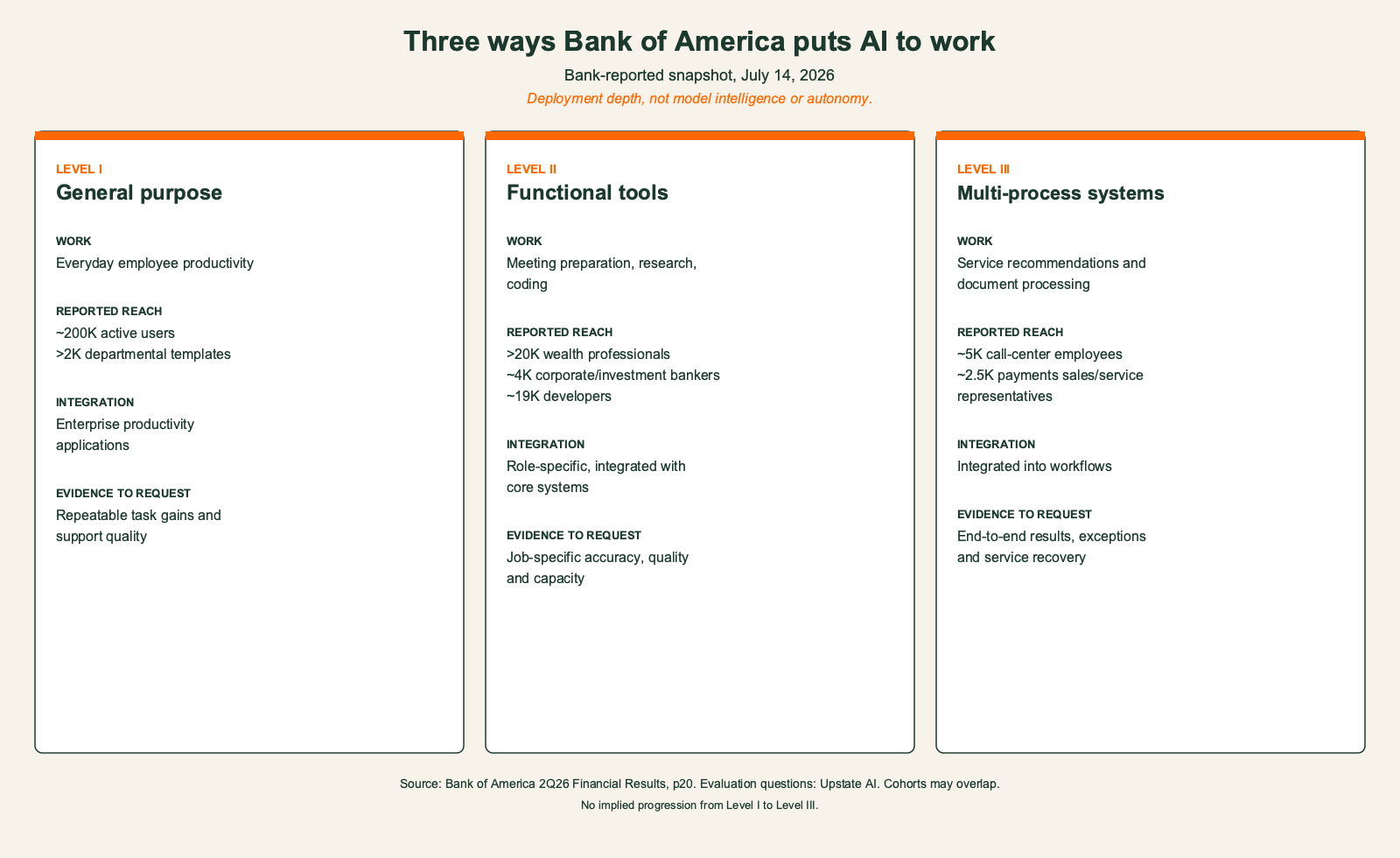
The bank's central AI slide, “Enhancing Work Through AI at Scale,” on page 20, organizes internal deployment into three levels. These describe how capabilities enter the work, rather than a progression from machine learning to generative AI to autonomous agents. A multi-process system isn't necessarily autonomous. The slide's “call center agents” are employees receiving recommendations.
| Field | Level I: General purpose | Level II: Functional tools | Level III: Multi-process systems |
|---|---|---|---|
| Work | Everyday employee productivity | Meeting preparation, research, coding | Service recommendations and document processing |
| Reported reach | ~200K active users; >2K departmental templates | >20K wealth professionals; ~4K corporate/investment bankers; ~19K developers | ~5K call-center employees; ~2.5K payments sales/service representatives |
| Integration | Enterprise productivity applications | Role-specific, integrated with core systems | Integrated into workflows |
| Evidence to request | Repeatable task gains and support quality | Job-specific accuracy, quality and capacity | End-to-end results, exceptions and service recovery |
Same map in text. Source: Bank of America 2Q26 Financial Results, p20. Evaluation questions: Upstate AI. Cohorts may overlap. No implied progression from Level I to Level III.
General-purpose tools: broad access
Level I covers AI integrated into enterprise-wide productivity applications. Alongside the active-user and prompt figures, the bank reports more than 2,000 departmental AI templates in use.
The templates are an important detail. General-purpose access leaves employees to work out where a tool helps and how to use it. Departmental material can make that capability more relevant to recurring tasks, although the slide doesn't disclose who maintains the templates or how their effectiveness is tested.
The appropriate management question at this level is whether people can use the tools reliably for their everyday work. Prompt volume alone can't answer it. A growing number of prompts could reflect broader adoption, more complex tasks or repeated attempts to get an acceptable answer. The deck doesn't provide the usage distribution or active-user measurement window needed to distinguish those possibilities.
Functional tools: support for a particular job
Level II covers role-specific applications integrated with core systems. The bank reports more than 20,000 wealth professionals equipped with AI for meeting-related activities, approximately 4,000 Corporate & Investment Banking professionals using it for research and presentation preparation, and approximately 19,000 developers using real-time coding assistance.
For developers, Bank of America reports a productivity increase above 20%. The slide doesn't provide the baseline, measurement period or method. That is a reported outcome worth investigating, not evidence of a corresponding reduction in engineering costs or an improvement in software quality.
The operating distinction is that the job now defines the application. Meeting preparation, banking research and software development require different information, outputs and checks. Evaluating them through one adoption target would obscure those differences.
For a smaller institution, a useful comparison might be a lending team preparing for borrower meetings. The question would be whether preparation becomes more complete and efficient while preserving source accuracy. Buying more licenses would be a poor substitute for measuring that job.
Multi-process systems: change the workflow
Level III includes approximately 5,000 call-center employees receiving automated recommendations, approximately 2,500 Global Payments Solutions sales and servicing representatives using AI to expedite responses, and an enterprise document-intelligence platform that searches, classifies, extracts and translates documents.
These examples move the analysis toward handoffs between tasks. A document may need to be located, classified and interpreted before its information can help someone answer a customer. The presentation identifies capabilities and intended benefits, but doesn't disclose the sequence of execution, approval boundaries or exception handling.
That missing detail matters most when something goes wrong. If a recommendation is incorrect, can the employee set it aside and still help the caller? Does the underlying evidence remain available? Can work continue when a connected service fails?
Those are questions to investigate, not evidence that Bank of America lacks controls. They are also the questions a smaller institution can take into its own evaluation. A fast recommendation that leaves an employee unable to recover is a service problem, even if the model usually performs well.
The foundation includes people
The same slide reports more than 600,000 AI training courses completed. Read alongside the departmental templates, that points to an investment in workforce enablement as well as software deployment. Course completions aren't unique employees, demonstrated proficiency or evidence that support continues after training.
For smaller institutions, the transferable question is local ownership. Who maintains the instructions when a policy or process changes? Who helps an employee who can't reconcile the AI's answer with the customer record? Who decides whether an application is useful enough to keep?
Those responsibilities are part of the operating cost. Without them, a successful launch can leave an institution with outdated materials, uneven practices and no clear route for reporting recurring failures. Training is a starting point; sustained use depends on people being able to get help and resolve mistakes.
Bank of America also depicts access to open-source and proprietary models and enabled cloud-hosting environments, with growth, efficiency, resilience and risk management as strategic principles. This supports a conclusion that its disclosed approach accommodates multiple model sources. It doesn't establish particular suppliers, a unified platform, easy portability or lower costs. Nor does “proprietary” tell us that the bank trained those models itself.
Erica is another part of the landscape
The consumer, wealth and commercial digital updates show Erica-powered engagement across those channels. The consumer update reports 200 million interactions in 2Q26, compared with 174 million a year earlier; the wealth and commercial pages report their own activity. These customer-facing metrics sit alongside the internal deployment framework, but they don't identify the model technology used or measure the same work. [Presentation, pp23, 25 and 27.]
An interaction isn't necessarily a resolved case, a unique customer or a satisfied customer. For service leaders, the next questions concern what was resolved, what needed escalation and how the customer experienced the result. The presentation's volume figures don't answer them.
One adjacent metric particularly needs care. Global Banking reports 26.7 million proactive alerts and insights, but its footnote includes scheduled reports, statements and other digital alerts as well as Erica-related activity. It isn't an AI-only interaction total. Combining it with chat volumes would exaggerate what the evidence establishes. [Presentation, p27, footnote 4.]
The broader finding is that customer AI and employee AI should be evaluated on their own terms. Internal preparation time, customer resolution and service satisfaction are different outcomes, even when related capabilities support them.
What the deployment numbers establish
Bank of America reports more than 300 approved AI and machine-learning use cases, alongside 114 live generative-AI use cases, 34 of them fully deployed. The difference between those labels is consequential. The slide doesn't define the scope of “live” or “fully deployed,” and doesn't establish that the AI/ML and GenAI populations are separate. Adding the counts would be unjustified. [Presentation, p20.]
The workforce cohorts may also overlap: a developer could use both general-purpose and functional tools. The presentation shouldn't be read as a set of employee counts to sum.
Taken together, the disclosures provide stronger evidence of reach and variety than of financial impact. The coding-productivity claim is more specific than the general statements about increased capacity or lower costs, but its measurement limitations remain. The deck doesn't provide a stand-alone account of AI costs and attributable savings that would explain its contribution to profit.
Our reading is that broad access and more deeply integrated applications can coexist as distinct investments. A general-purpose tool doesn't become obsolete because a specialist application is introduced. Equally, high general-purpose usage doesn't establish that a complex service workflow has improved.
There is a reasonable competing reading: the three levels could be a polished investor framework organizing selected examples, rather than evidence of a unified operating system. The presentation doesn't disclose enough about ownership, evaluation, data architecture or shared infrastructure to settle that question. Its organizing logic is useful without claiming more coherence than the source demonstrates.
A smaller institution's working version
The practical adaptation is to map a manageable set of jobs, then assign an owner and an outcome to each. Some may need general-purpose tools; others may justify a maintained application or deeper integration. An existing system or fixed workflow may be sufficient.
For one candidate job, the following worksheet makes the decision concrete. It is an Upstate AI working aid, not Bank of America's framework or a regulatory checklist.
| Question | Record the institution's answer |
|---|---|
| What work would change? | Name the task, its current process and the simplest alternative. |
| Who owns the result? | Name the accountable process owner and the person responsible for ongoing support and content changes. |
| What would count as improvement? | Record the current baseline and the measure that matters: completion time, accuracy, rework, capacity or customer resolution. Include operating and review costs. |
| Who is affected if it fails? | Identify the customer, member or employee impact and how the team would detect the failure promptly. |
| What would make us stop, and how would service continue? | Specify the unacceptable error or condition, who can suspend use and the fallback process. |
Test against representative, approved cases before expanding the use. If the result is faster preparation but unchanged turnaround or more rework, that should shape the next decision. If the existing process performs better, keeping it is a valid outcome.
Bank of America's volumes aren't targets for a smaller institution. The more useful benchmark is whether leadership can explain what each AI investment changes, who owns its performance and what evidence shows that the work improved.
Source and method
This research analyzes Bank of America's 2Q26 Financial Results presentation, dated July 14, 2026, particularly pages 20, 23, 25, 27, 31 and 32. Source text and page references were checked November 10, 2026. Figures are bank-reported and haven't been independently audited by Upstate AI. Interpretations and the worksheet are ours; the lending example is illustrative. Subsequent deployments and product changes are outside this dated snapshot.
Upstate AI helps banks and credit unions understand, evaluate and implement AI on established platforms. Ben Nichols, founder and principal consultant, works with institutions on AI strategy, implementation and governance, and teaches AI at Syracuse University. ben@up-state-ai.com