Learn: What is an LLM?
A short walk through what a large language model actually does, and what it does not.

Everyone keeps hearing "LLM." Those letters stand for large language model. That is the engine behind most of the chat tools showing up in vendor demos, employee browsers, and board packets. It is not a person, and it is not a complete banking system. It simply predicts language. Everything else, memory, tools, permissions, sits around it as part of an AI ecosystem.
The clip below is a short walk through four ideas we've been teaching to banking groups: where an LLM sits in the AI family, how it generates the next token, how you call it, and where memory actually lives.
AI spans several capabilities
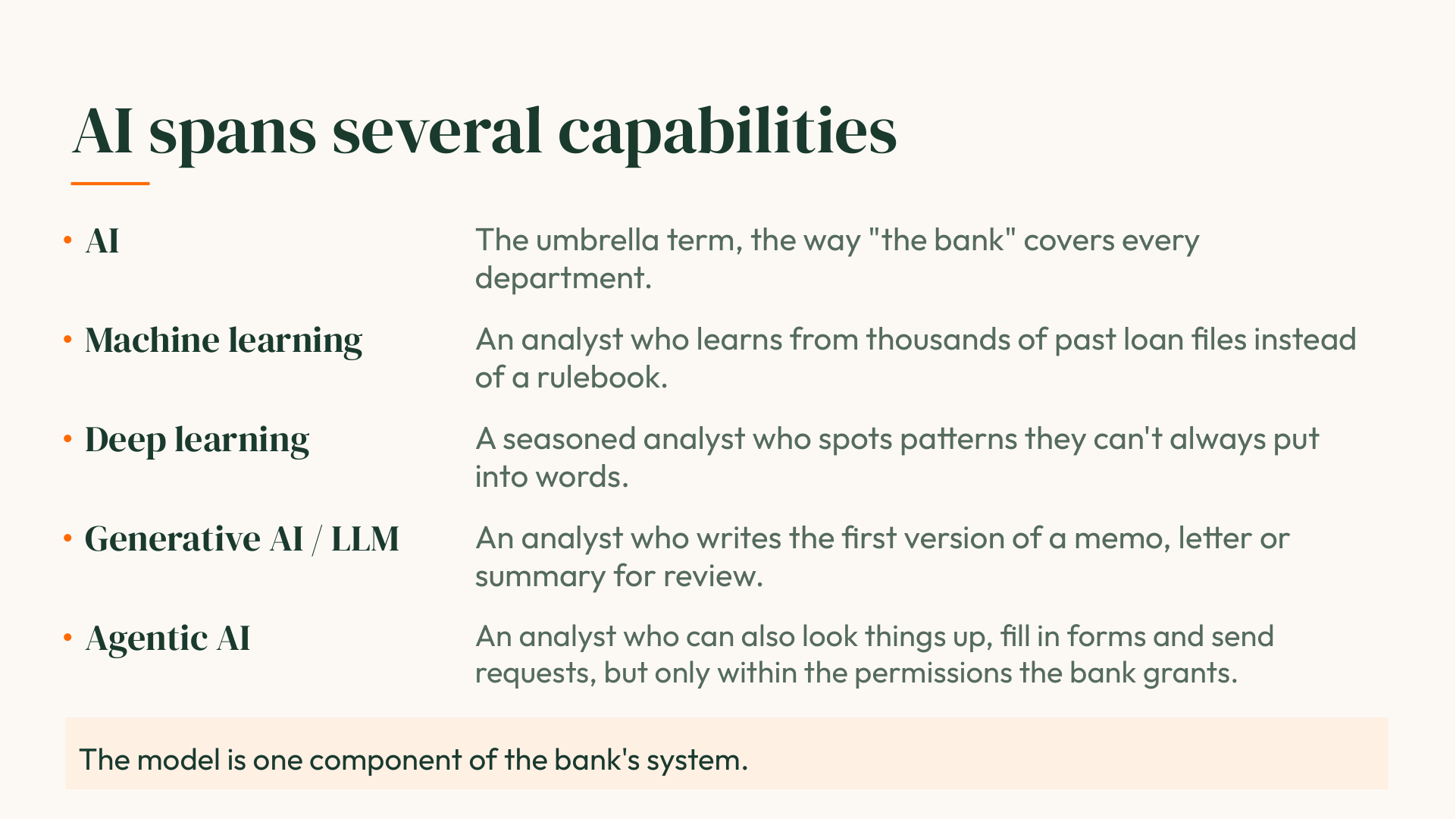
AI is an umbrella term, the way "the bank" covers lending, operations, and branchs. Machine learning is one way of doing AI. It learns patterns from examples instead of following a rulebook you wrote line by line. Deep learning is a form of machine learning that uses multilayer neural networks, programs that are modeled on brain activity. The useful analogy is a seasoned analyst who can spot a pattern they can't necessarily put into words.
Generative AI produces content. A large language model is the language version of that: a drafter that will write the first version of a memo, a letter, or a summary for someone to review. AI agent (agentic) systems go even further. They can look things up in a folder or database, fill in forms, or send requests by email or Teams, but only inside permissions the bank actually grants.
Those labels are related, but not as five rungs on a maturity ladder. You can have a strong model and still have a weak system. Reading a scanned loan file is a capability. Writing the amount into the loan record is a permission. The AI model is just one component, while the bank still owns the rest.
An LLM is a next-token prediction machine
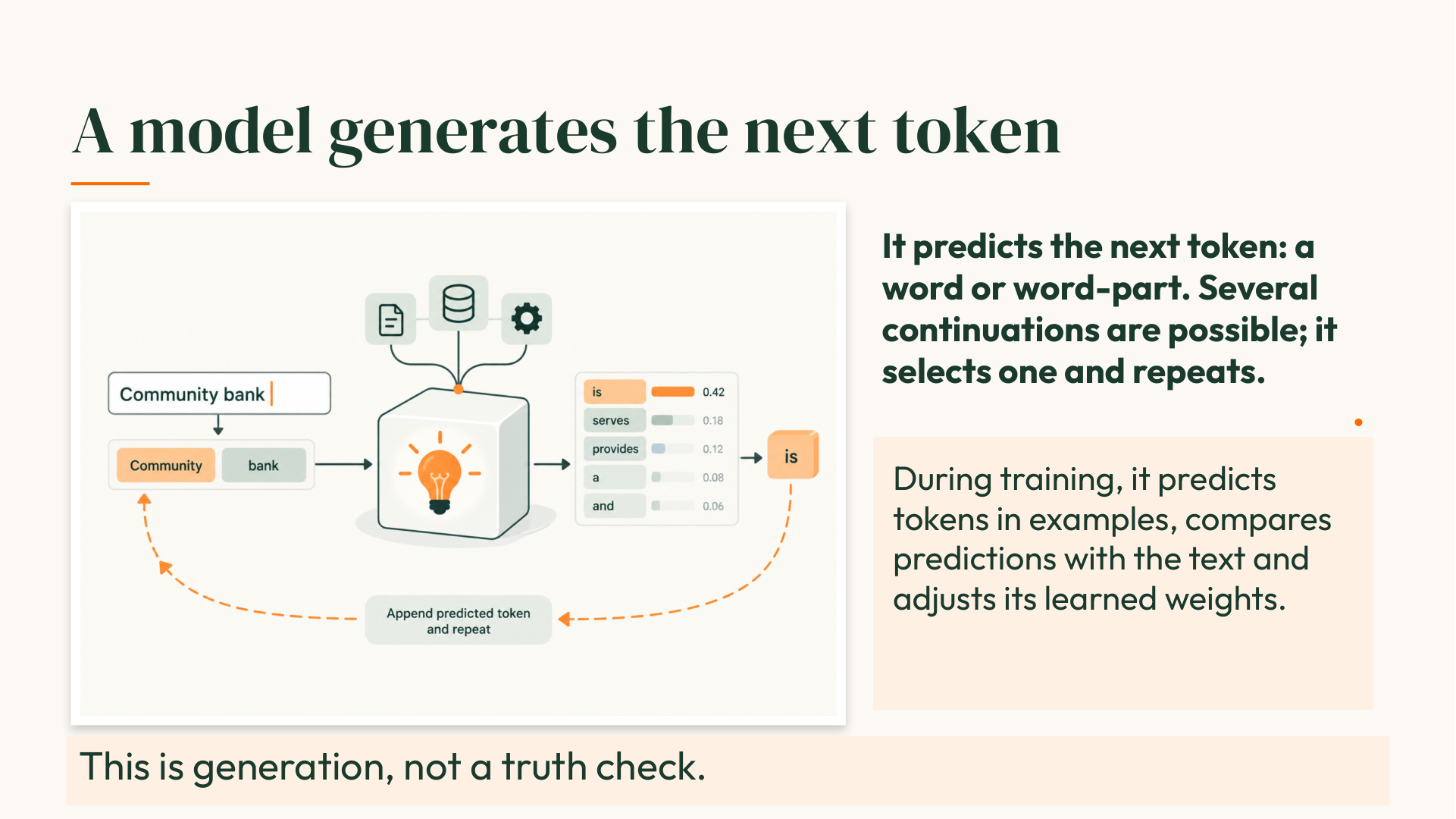
Simply put, a large language model's job is to predict the next token in a sequence - like fill in the blank. A token is a word, part of a word, or punctuation. You send a prompt, question, request to the LLM. The model then returns several possible next tokens based on probability, selects one, appends it back to input prompt, and repeats until it stops.
On the diagram above, you'll see "community bank" is split into tokens. The model then ranks possible next words: is, serves, provides, and so on. The LLM samples from this distribution and picks one and loops again.
Initial LLM training is a completely different operation. During training phase, the model predicts tokens in examples, compares those predictions with the actual text, and adjusts its learned probabilities, called weights. An important distinction is that a question you ask in a chat session does not retrain the model; it does not learn from these types of interactions. LLMs only learn during discrete training.
Additionally, content generation may not always yield the truth, sometimes called hallucination. This occurs because these LLMs were optimized to sound pleasing to humans, not optimized for truth. Sounding right and being right are different jobs. That is why a fluent credit-memo draft still needs a person to check the figures against the file.
Intelligence is available on call
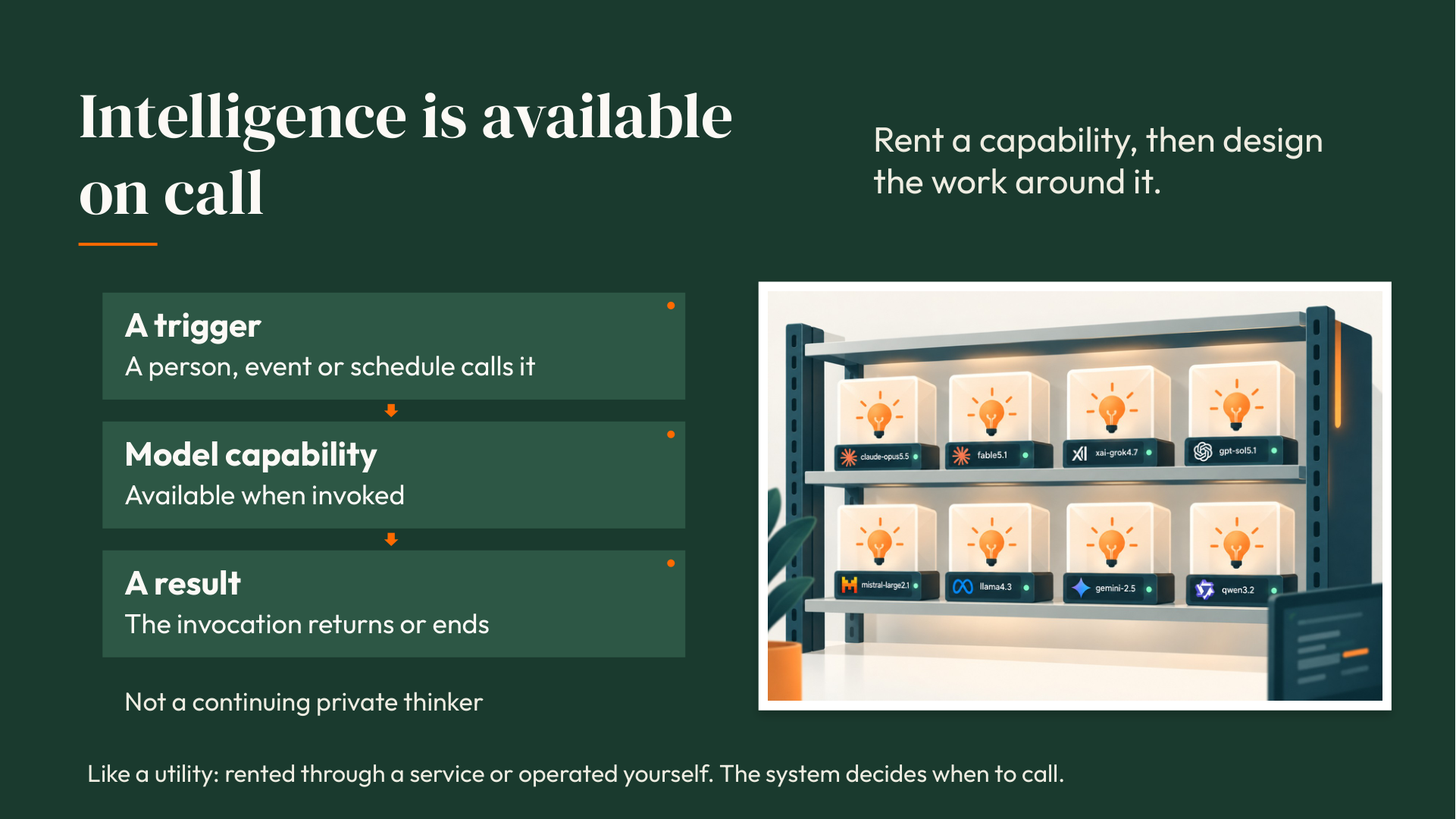
Think of an LLM as intelligence as a service. LLMs sit on a shelf. You do not buy a robot that thinks about your bank all night. You rent a capability, or you operate one yourself, and you design the work around when it gets invoked or called.
A trigger starts the workflow, such as a person, an event, or a schedule. The model is available when invoked as a service. Then a result comes back and the invocation ends. The LLM is not a continuing private thinker between these service events.
Language models produce variable output, so someone still has to decide whether the result is fit for the task. The software system around the model, not the prompt, decides when to invoke it for a content generation task.
Memory lives in the system
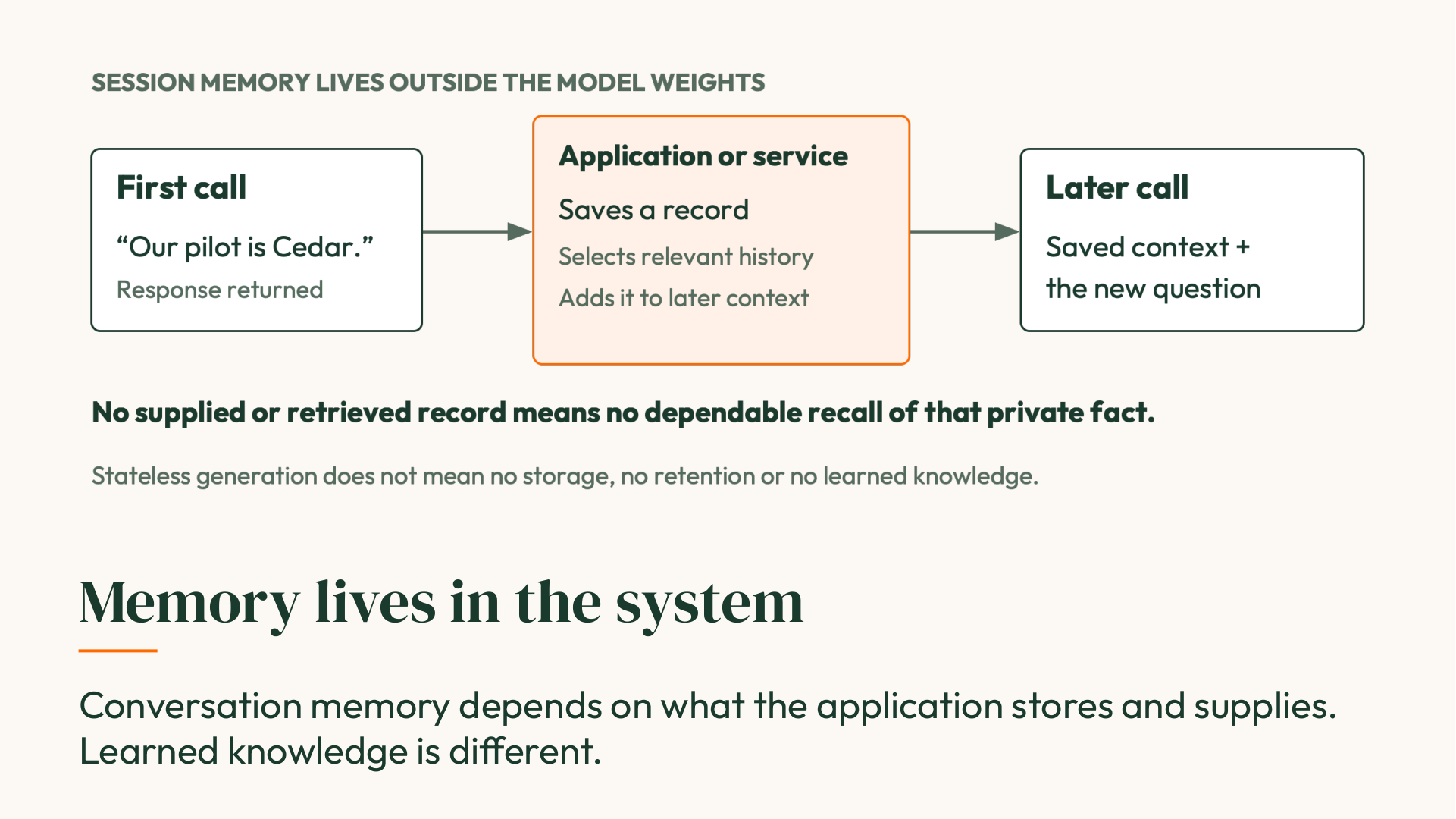
People talk as if the model remembers them. Conversation memory does not live in a continuous mind. It lives in the software application or service that stores a record in a file or database and feeds it back.
First call: you tell it your private pilot's name is Cedar. It answers. If the application saves that, selects it later, and includes it with the next question, the later call can use it. If nothing is stored or retrieved, you should not rely on recall of that private fact.
Memoryless generation does not mean nothing is stored. Retention, logs, and training terms are separate contract questions for your AI vendor. Learned knowledge in the weights is also different from a saved chat. The model may contain public patterns about a famous person.
In banking you will hear RAG, retrieval augmented generation. That is pulling the right documents in at the moment of the question so the model has context to work with. It is reading, not learning. The question that matters is who controls that context, and whether the model is allowed to act on it.
Upstate AI helps banks and credit unions understand, evaluate and implement AI on established platforms. Its founder, Ben Nichols, works with institutions on AI strategy, implementation and governance, and teaches AI at Syracuse University. ben@up-state-ai.com